第3课:自由波段输入
作者: 叶粟 (remotesensingsuy@gmail.com)
时间序列数据集: Sentinel-2
应用: 中国河南的作物物候动态
标准的 CCDC 方法只支持七个 Landsat 波段作为输入。pyxccd 为 COLD(cold_detect_flex)和 S-CCD(sccd_detect_flex)提供了一个“自由波段输入”,允许输入任意组合的波段、指数或多传感器时间序列。
来自非 Landsat 传感器的输入
以监测作物动态为例,我们使用 Sentinel-2 作为输入。我们将从为 cold_detect_flex 和 sccd_detect_flex 输入所有 Sentinel-2 波段开始:
import numpy as np
import os
import pathlib
import pandas as pd
from dateutil import parser
# Imports from this package
from typing import List, Tuple, Dict, Union, Optional
from matplotlib.axes import Axes
import seaborn as sns
import matplotlib.pyplot as plt
from pyxccd import sccd_detect_flex, cold_detect_flex
from pyxccd.common import SccdOutput, cold_rec_cg
from pyxccd.utils import getcategory_sccd, defaults, getcategory_cold

def display_cold_result(
    data: np.ndarray,
    band_names: List[str],
    band_index: int,
    cold_result: cold_rec_cg,
    axe: Axes,
    title: str = 'COLD',
    plot_kwargs: Optional[Dict] = None
) -> Tuple[plt.Figure, List[plt.Axes]]:
    """
    Compare COLD and SCCD change detection algorithms by plotting their results side by side.

    This function takes time series remote sensing data, applies both COLD algorithms,
    and visualizes the curve fitting and break detection results.

    Parameters:
    -----------
    data : np.ndarray
        Input data array with shape (n_observations, n_bands + 2) where:
        - First column: ordinal dates (days since January 1, AD 1)
        - Next n_bands columns: spectral band values
        - Last column: QA flags (0-clear, 1-water, 2-shadow, 3-snow, 4-cloud)

    band_names : List[str]
        List of band names corresponding to the spectral bands in the data (e.g., ['red', 'nir'])

    band_index : int
        1-based index of the band to plot (e.g., 0 for first band, 1 for second band)

    axe: Axes
        An Axes object represents a single plot within that Figure

    title: Str
        The figure title. The default is "COLD"

    plot_kwargs : Dict, optional
        Additional keyword arguments to pass to the display function. Possible keys:
        - 'marker_size': size of observation markers (default: 5)
        - 'marker_alpha': transparency of markers (default: 0.7)
        - 'line_color': color of model fit lines (default: 'orange')
        - 'font_size': base font size (default: 14)

    Returns:
    --------
    Tuple[plt.Figure, List[plt.Axes]]
        A tuple containing the matplotlib Figure object and a list of Axes objects
        (top axis is COLD results, bottom axis is SCCD results)

    """
    w = np.pi * 2 / 365.25

    # Set default plot parameters
    default_plot_kwargs: Dict[str, Union[int, float, str]] = {
        'marker_size': 5,
        'marker_alpha': 0.7,
        'line_color': 'orange',
        'font_size': 14
    }
    if plot_kwargs is not None:
        default_plot_kwargs.update(plot_kwargs)

    # Extract values with proper type casting
    font_size = default_plot_kwargs.get('font_size', 14)
    try:
        title_font_size = int(font_size) + 2
    except (TypeError, ValueError):
        title_font_size = 16


    # Clean and prepare data
    data = data[np.all(np.isfinite(data), axis=1)]
    data_df = pd.DataFrame(data, columns=['dates'] + band_names + ['qa'])

    # Plot COLD results
    w = np.pi * 2 / 365.25
    slope_scale = 10000

    # Prepare clean data for COLD plot
    data_clean = data_df[(data_df['qa'] == 0) | (data_df['qa'] == 1)].copy()
    data_clean =  data_clean[(data_clean >= 0).all(axis=1) & (data_clean.drop(columns="dates") <= 10000).all(axis=1)]
    calendar_dates = [pd.Timestamp.fromordinal(int(row)) for row in data_clean["dates"]]
    data_clean.loc[:, 'dates_formal'] = calendar_dates

    # Calculate y-axis limits
    band_name = band_names[band_index]
    band_values = data_clean[data_clean['qa'] == 0][band_name]
    q01, q99 = np.quantile(band_values, [0.01, 0.99])
    extra = (q99 - q01) * 0.4
    ylim_low = q01 - extra
    ylim_high = q99 + extra

    # Plot COLD observations
    axe.plot(
        'dates_formal', band_name, 'go',
        markersize=default_plot_kwargs['marker_size'],
        alpha=default_plot_kwargs['marker_alpha'],
        data=data_clean
    )

    # Plot COLD segments
    for segment in cold_result:
        j = np.arange(segment['t_start'], segment['t_end'] + 1, 1)
        plot_df = pd.DataFrame({
            'dates': j,
            'trend': j * segment['coefs'][band_index][1] / slope_scale + segment['coefs'][band_index][0],
            'annual': np.cos(w * j) * segment['coefs'][band_index][2] + np.sin(w * j) * segment['coefs'][band_index][3],
            'semiannual': np.cos(2 * w * j) * segment['coefs'][band_index][4] + np.sin(2 * w * j) * segment['coefs'][band_index][5],
            'trimodel': np.cos(3 * w * j) * segment['coefs'][band_index][6] + np.sin(3 * w * j) * segment['coefs'][band_index ][7]
        })
        plot_df['predicted'] = (
            plot_df['trend'] +
            plot_df['annual'] +
            plot_df['semiannual'] +
            plot_df['trimodel']
        )

        # Convert dates and plot model fit
        calendar_dates = [pd.Timestamp.fromordinal(int(row)) for row in plot_df["dates"]]
        plot_df.loc[:, 'dates_formal'] = calendar_dates
        g = sns.lineplot(
            x="dates_formal", y="predicted",
            data=plot_df,
            label="Model fit",
            ax=axe,
            color=default_plot_kwargs['line_color']
        )
        if g.legend_ is not None:
            g.legend_.remove()

    # Plot breaks
    for i in range(len(cold_result)):
        if  cold_result[i]['change_prob'] == 100:
            if getcategory_cold(cold_result, i) == 1:
                axe.axvline(pd.Timestamp.fromordinal(cold_result[i]['t_break']), color='k')
            else:
                axe.axvline(pd.Timestamp.fromordinal(cold_result[i]['t_break']), color='r')

    axe.set_ylabel(f"{band_name} * 10000", fontsize=default_plot_kwargs['font_size'])

    # Handle tick params with type safety
    tick_font_size = default_plot_kwargs['font_size']
    if isinstance(tick_font_size, (int, float)):
        axe.tick_params(axis='x', labelsize=int(tick_font_size)-1)
    else:
        axe.tick_params(axis='x', labelsize=13)  # fallback

    axe.set(ylim=(ylim_low, ylim_high))
    axe.set_xlabel("", fontsize=6)

    # Format spines
    for spine in axe.spines.values():
        spine.set_edgecolor('black')
    title_font_size = int(font_size) + 2 if isinstance(font_size, (int, float)) else 16
    axe.set_title(title, fontweight="bold", size=title_font_size, pad=2)


def display_sccd_result(
    data: np.ndarray,
    band_names: List[str],
    band_index: int,
    sccd_result: SccdOutput,
    axe: Axes,
    title: str = 'S-CCD',
    plot_kwargs: Optional[Dict] = None
) -> Tuple[plt.Figure, List[plt.Axes]]:
    """
    Compare COLD and SCCD change detection algorithms by plotting their results side by side.

    This function takes time series remote sensing data, applies both COLD and SCCD algorithms,
    and visualizes the curve fitting and break detection results for comparison.

    Parameters:
    -----------
    data : np.ndarray
        Input data array with shape (n_observations, n_bands + 2) where:
        - First column: ordinal dates (days since January 1, AD 1)
        - Next n_bands columns: spectral band values
        - Last column: QA flags (0-clear, 1-water, 2-shadow, 3-snow, 4-cloud)

    band_names : List[str]
        List of band names corresponding to the spectral bands in the data (e.g., ['red', 'nir'])

    band_index : int
        1-based index of the band to plot (e.g., 0 for first band, 1 for second band)

    sccd_result: SccdOutput
        Output of sccd_detect

    axe: Axes
        An Axes object represents a single plot within that Figure

    title: Str
        The figure title. The default is "S-CCD"

    plot_kwargs : Dict, optional
        Additional keyword arguments to pass to the display function. Possible keys:
        - 'marker_size': size of observation markers (default: 5)
        - 'marker_alpha': transparency of markers (default: 0.7)
        - 'line_color': color of model fit lines (default: 'orange')
        - 'font_size': base font size (default: 14)

    Returns:
    --------
    Tuple[plt.Figure, List[plt.Axes]]
        A tuple containing the matplotlib Figure object and a list of Axes objects
        (top axis is COLD results, bottom axis is SCCD results)

    """
    w = np.pi * 2 / 365.25

    # Set default plot parameters
    default_plot_kwargs: Dict[str, Union[int, float, str]] = {
        'marker_size': 5,
        'marker_alpha': 0.7,
        'line_color': 'orange',
        'font_size': 14
    }
    if plot_kwargs is not None:
        default_plot_kwargs.update(plot_kwargs)

    # Extract values with proper type casting
    font_size = default_plot_kwargs.get('font_size', 14)
    try:
        title_font_size = int(font_size) + 2
    except (TypeError, ValueError):
        title_font_size = 16


    # Clean and prepare data
    data = data[np.all(np.isfinite(data), axis=1)]
    data_df = pd.DataFrame(data, columns=['dates'] + band_names + ['qa'])


    # Plot COLD results
    w = np.pi * 2 / 365.25
    slope_scale = 10000

    # Prepare clean data for COLD plot
    data_clean = data_df[(data_df['qa'] == 0) | (data_df['qa'] == 1)].copy()
    data_clean =  data_clean[(data_clean >= 0).all(axis=1) & (data_clean.drop(columns="dates") <= 10000).all(axis=1)]
    calendar_dates = [pd.Timestamp.fromordinal(int(row)) for row in data_clean["dates"]]
    data_clean.loc[:, 'dates_formal'] = calendar_dates

    # Calculate y-axis limits
    band_name = band_names[band_index]
    band_values = data_clean[data_clean['qa'] == 0 | (data_clean['qa'] == 1)][band_name]
    # band_values  = band_values[band_values <10000]
    q01, q99 = np.quantile(band_values, [0.01, 0.99])
    extra = (q99 - q01) * 0.4
    ylim_low = q01 - extra
    ylim_high = q99 + extra

    # Plot SCCD observations
    axe.plot(
        'dates_formal', band_name, 'go',
        markersize=default_plot_kwargs['marker_size'],
        alpha=default_plot_kwargs['marker_alpha'],
        data=data_clean
    )

    # Plot SCCD segments
    for segment in sccd_result.rec_cg:
        j = np.arange(segment['t_start'], segment['t_break'] + 1, 1)
        if len(segment['coefs'][band_index]) == 8:
            plot_df = pd.DataFrame(
                {
                'dates': j,
                'trend': j * segment['coefs'][band_index][1] / slope_scale + segment['coefs'][band_index][0],
                'annual': np.cos(w * j) * segment['coefs'][band_index][2] + np.sin(w * j) * segment['coefs'][band_index][3],
                'semiannual': np.cos(2 * w * j) * segment['coefs'][band_index][4] + np.sin(2 * w * j) * segment['coefs'][band_index][5],
                'trimodal': np.cos(3 * w * j) * segment['coefs'][band_index][6] + np.sin(3 * w * j) * segment['coefs'][band_index][7]
            })
        else:
            plot_df = pd.DataFrame(
                {
                'dates': j,
                'trend': j * segment['coefs'][band_index][1] / slope_scale + segment['coefs'][band_index][0],
                'annual': np.cos(w * j) * segment['coefs'][band_index][2] + np.sin(w * j) * segment['coefs'][band_index][3],
                'semiannual': np.cos(2 * w * j) * segment['coefs'][band_index][4] + np.sin(2 * w * j) * segment['coefs'][band_index][5],
                'trimodal': j * 0
            })
        plot_df['predicted'] = (
            plot_df['trend'] +
            plot_df['annual'] +
            plot_df['semiannual']+
            plot_df['trimodal']
        )

        # Convert dates and plot model fit
        calendar_dates = [pd.Timestamp.fromordinal(int(row)) for row in plot_df["dates"]]
        plot_df.loc[:, 'dates_formal'] = calendar_dates
        g = sns.lineplot(
            x="dates_formal", y="predicted",
            data=plot_df,
            label="Model fit",
            ax=axe,
            color=default_plot_kwargs['line_color']
        )
        if g.legend_ is not None:
            g.legend_.remove()

    # Plot near-real-time projection for SCCD if available
    if hasattr(sccd_result, 'nrt_mode') and (sccd_result.nrt_mode %10 == 1 or sccd_result.nrt_mode == 3 or sccd_result.nrt_mode %10 == 5):
        recent_obs = sccd_result.nrt_model['obs_date_since1982'][sccd_result.nrt_model['obs_date_since1982']>0]
        j = np.arange(
            sccd_result.nrt_model['t_start_since1982'].item() + defaults['COMMON']['JULIAN_LANDSAT4_LAUNCH'],
            recent_obs[-1].item()+ defaults['COMMON']['JULIAN_LANDSAT4_LAUNCH']+1,
            1
        )

        if len(sccd_result.nrt_model['nrt_coefs'][band_index]) == 8:
            plot_df = pd.DataFrame(
                {
                'dates': j,
                'trend': j * sccd_result.nrt_model['nrt_coefs'][band_index][1] / slope_scale + sccd_result.nrt_model['nrt_coefs'][band_index][0],
                'annual': np.cos(w * j) * sccd_result.nrt_model['nrt_coefs'][band_index][2] + np.sin(w * j) * sccd_result.nrt_model['nrt_coefs'][band_index][3],
                'semiannual': np.cos(2 * w * j) * sccd_result.nrt_model['nrt_coefs'][band_index][4] + np.sin(2 * w * j) * sccd_result.nrt_model['nrt_coefs'][band_index][5],
                'trimodal': np.cos(3 * w * j) * sccd_result.nrt_model['nrt_coefs'][band_index][6] + np.sin(3 * w * j) * sccd_result.nrt_model['nrt_coefs'][band_index][7]
            })
        else:
            plot_df = pd.DataFrame(
                {
                'dates': j,
                'trend': j * sccd_result.nrt_model['nrt_coefs'][band_index][1] / slope_scale + sccd_result.nrt_model['nrt_coefs'][band_index][0],
                'annual': np.cos(w * j) * sccd_result.nrt_model['nrt_coefs'][band_index][2] + np.sin(w * j) * sccd_result.nrt_model['nrt_coefs'][band_index][3],
                'semiannual': np.cos(2 * w * j) * sccd_result.nrt_model['nrt_coefs'][band_index][4] + np.sin(2 * w * j) * sccd_result.nrt_model['nrt_coefs'][band_index][5],
                'trimodal': j * 0
            })

        plot_df['predicted'] = plot_df['trend'] + plot_df['annual'] + plot_df['semiannual']+ plot_df['trimodal']
        calendar_dates = [pd.Timestamp.fromordinal(int(row)) for row in plot_df["dates"]]
        plot_df.loc[:, 'dates_formal'] = calendar_dates
        g = sns.lineplot(
            x="dates_formal", y="predicted",
            data=plot_df,
            label="Model fit",
            ax=axe,
            color=default_plot_kwargs['line_color']
        )
        if g.legend_ is not None:
            g.legend_.remove()

    # Plot breaks
    for i in range(len(sccd_result.rec_cg)):
        if getcategory_sccd(sccd_result.rec_cg, i) == 1:
            axe.axvline(pd.Timestamp.fromordinal(sccd_result.rec_cg[i]['t_break']), color='k')
        else:
            axe.axvline(pd.Timestamp.fromordinal(sccd_result.rec_cg[i]['t_break']), color='r')

    axe.set_ylabel(f"{band_name} * 10000", fontsize=default_plot_kwargs['font_size'])

    # Handle tick params with type safety
    tick_font_size = default_plot_kwargs['font_size']
    if isinstance(tick_font_size, (int, float)):
        axe.tick_params(axis='x', labelsize=int(tick_font_size)-1)
    else:
        axe.tick_params(axis='x', labelsize=13)  # fallback

    axe.set(ylim=(ylim_low, ylim_high))
    axe.set_xlabel("", fontsize=6)

    # Format spines
    for spine in axe.spines.values():
        spine.set_edgecolor('black')
    title_font_size = int(font_size) + 2 if isinstance(font_size, (int, float)) else 16
    axe.set_title(title, fontweight="bold", size=title_font_size, pad=2)


TUTORIAL_DATASET = (pathlib.Path.cwd() / 'datasets').resolve() # modify it as you need
assert TUTORIAL_DATASET.exists()

in_path = TUTORIAL_DATASET/ '3_crop_sentinel2.csv' # read the MPB-affected plot in CO

# read example csv for HLS time series
data = pd.read_csv(in_path)

# split the array by the column
Tile, B1, B2, B3, B4, B5, B6, B7, B8, B8A, B9, B11, B12, QA60 = data.to_numpy().copy().T

dates = np.array([parser.parse(tilename[0:8]).toordinal() for tilename in Tile])
qas = QA60.copy()

# Bit 10: Opaque clouds; Bit 11: Cirrus clouds
qas[qas>0] = 4

# for the flexible mode, we need to stack the chosen inputted bands into one array.
# Let's choose the bands with the resolution smaller than 60 meters.
# B4 is green band, B12 is SWIR1, so they were chosen for tmask  (tmask_b1_index=3, tmask_b2_index=9).
sccd_result = sccd_detect_flex(dates.astype(np.int32), np.stack((B2, B3, B4, B5, B6, B7, B8, B8A,  B11, B12), axis=1).astype(np.int32), qas.astype(np.int32), lam=20,  tmask_b1_index=3, tmask_b2_index=9)
cold_result = cold_detect_flex(dates.astype(np.int32), np.stack((B2, B3, B4, B5, B6, B7, B8, B8A,  B11, B12), axis=1).astype(np.int32), qas.astype(np.int32), lam=20,  tmask_b1_index=3, tmask_b2_index=9)


# Set up plotting style
sns.set_theme(style="darkgrid")
sns.set_context("notebook")

# plot time series and detection results
fig, axes = plt.subplots(2, 1, figsize=(12, 7))
plt.subplots_adjust(hspace=0.4)

display_cold_result(data=np.stack((dates, B2, B3, B4, B5, B6, B7, B8, B8A,  B11, B12, qas), axis=1).astype(np.int64), band_names=['blues', 'green', 'red', 'edge1', 'edge2','edge3', 'nir', 'edge4', 'swir1', 'swir2'], band_index=6, cold_result=cold_result, axe=axes[0], title="COLD (10 bands)")

display_sccd_result(data=np.stack((dates, B2, B3, B4, B5, B6, B7, B8, B8A,  B11, B12, qas), axis=1).astype(np.int64), band_names=['blues', 'green', 'red', 'edge1', 'edge2','edge3', 'nir', 'edge4', 'swir1', 'swir2'], band_index=6, sccd_result=sccd_result, axe=axes[1], title="S-CCD (10 bands)")
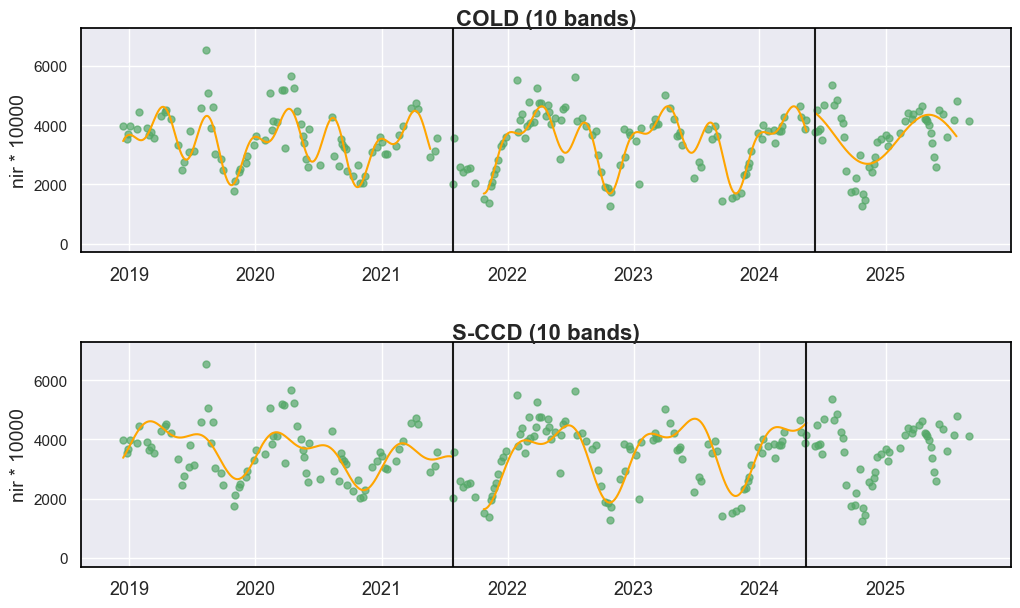
第二个断点之后,S-CCD 尚未建立监测模型(即 nrt_mode 为 2)。因此,在这种情况下,2024 年之后没有显示拟合曲线。
与标准的 cold_detect 和 sccd_detect 相比,灵活版本(cold_detect_flex 和 sccd_detect_flex)要求用户明确指定 lambda 和 Tmask 波段索引:
Lambda:用户必须提供一个
lambda值,因为不同传感器可能具有不同的反射率值范围。如果输入数据缩放到 [0, 10000],我们建议使用默认的 CCDC 设置(lambda=20)。通常,lambda 应根据实际输入范围相对于默认 Landsat 范围(10,000)进行缩放。例如,如果输入范围为 [0, 20000],则新的 lambda 将为 20 * 20000 / 10000 = 40。Tmask 波段索引:在标准函数中,Tmask 硬编码为使用绿波段和短波红外1波段(即对于 Landsat,
tmask_b1_index = 2,tmask_b2_index = 5)。这些波段用于从时间序列中过滤掉受云或噪声影响的观测值。在自由波段输入下,波段索引作为用户定义参数公开,因为 Sentinel-2 等传感器或替代预处理数据集可能使用不同的波段顺序。
对于此案例,COLD 和 S-CCD 都检测到两个与作物动态相关的断点。2021 年的第一个断点与 农田在 2021 年秋季休耕(特征是近红外值低) 有关。2024 年的第二个断点可能与 作物类型或品种变化有关,因为第二个生长季的近红外值明显高于正常值。
三级谐波 S-CCD
在上面的例子中,与 COLD 相比,S-CCD 显示出较弱的拟合度,由于均方根误差(RMSE)增加,未能检测到 COLD 检测到的第二个断点。这里的主要原因是该农田 每年有两个生长周期,而标准的 S-CCD 仅用两个分量(年际和半年际)模拟季节性,优先顾及计算效率和最小存储。相比之下,COLD 包含三个分量(年际、半年际和四月期周期),这使得在有两个生长季节的情况下能够进行更准确的拟合。为了解决这个问题,S-CCD 的自由波段输入提供了一个 trimodal 选项,允许用户包含四月期周期,并为农田像元实现更好的曲线拟合。
# enable trimodal
sccd_result = sccd_detect_flex(dates.astype(np.int32), np.stack((B2, B3, B4, B5, B6, B7, B8, B8A,  B11, B12), axis=1).astype(np.int32), qas.astype(np.int32), lam=20, tmask_b1_index=3, tmask_b2_index=9, trimodal=True)


# Set up plotting style
sns.set_theme(style="darkgrid")
sns.set_context("notebook")

# plot time series and detection results
fig, axes = plt.subplots(2, 1, figsize=(12, 7))
plt.subplots_adjust(hspace=0.4)

display_cold_result(data=np.stack((dates, B2, B3, B4, B5, B6, B7, B8, B8A,  B11, B12, qas), axis=1).astype(np.int64), band_names=['blues', 'green', 'red', 'edge1', 'edge2','edge3', 'nir', 'edge4', 'swir1', 'swir2'], band_index=6, cold_result=cold_result, axe=axes[0], title="COLD (10 bands)")

display_sccd_result(data=np.stack((dates, B2, B3, B4, B5, B6, B7, B8, B8A,  B11, B12, qas), axis=1).astype(np.int64), band_names=['blues', 'green', 'red', 'edge1', 'edge2','edge3', 'nir', 'edge4', 'swir1', 'swir2'], band_index=6, sccd_result=sccd_result, axe=axes[1], title="Trimodal S-CCD (10 bands)")
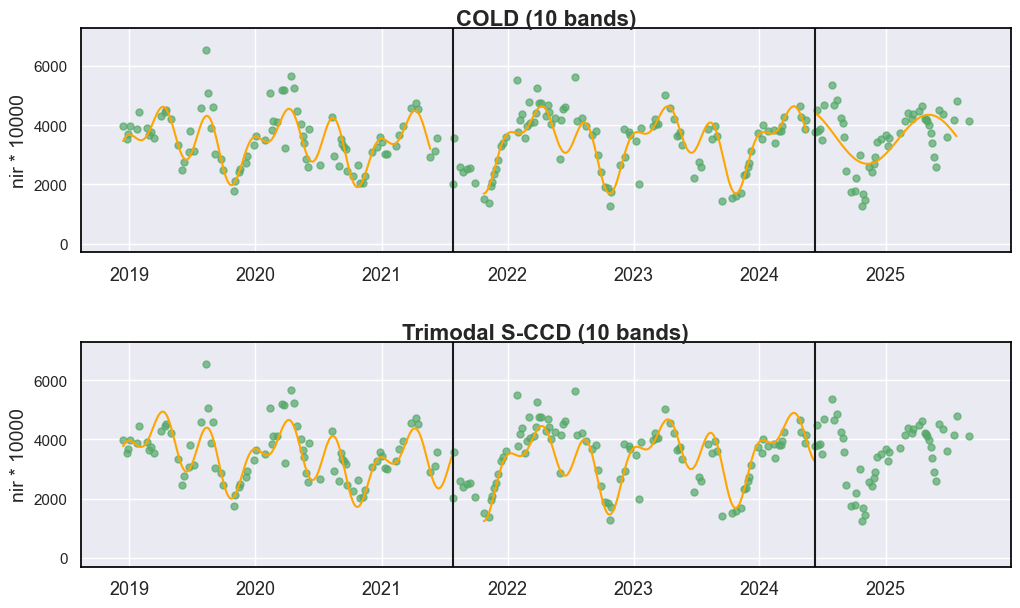
如上所示,S-CCD 和 COLD 生成的拟合曲线几乎相同,并且两种方法产生了相同的断点检测结果。
结合植被指数
有时,仅依靠所有原始的 Sentinel-2 光谱波段作为输入并不能产生令人满意的断点检测性能。在下一节中,我们将探讨结合光谱波段和植被指数是否能改善结果。
输入植被指数
Sentinel-2 MSI 覆盖 13 个光谱波段,表示如下:
Sentinel-2 波段 |
中心波长 (µm) |
分辨率 (米) |
|---|---|---|
Band 1 - Coastal aerosol |
0.443 |
60 |
Band 2 - Blue |
0.490 |
10 |
Band 3 - Green |
0.560 |
10 |
Band 4 - Red |
0.665 |
10 |
Band 5 - Red Edge |
0.705 |
20 |
Band 6 - Red Edge |
0.740 |
20 |
Band 7 - Red Edge |
0.783 |
20 |
Band 8 - NIR |
0.842 |
10 |
Band 8A - Red Edge |
0.865 |
20 |
Band 9 - Water vapour |
0.945 |
60 |
Band 10 - SWIR-Cirrus |
1.375 |
60 |
Band 11 - SWIR |
1.610 |
20 |
Band 12 - SWIR |
2.190 |
20 |
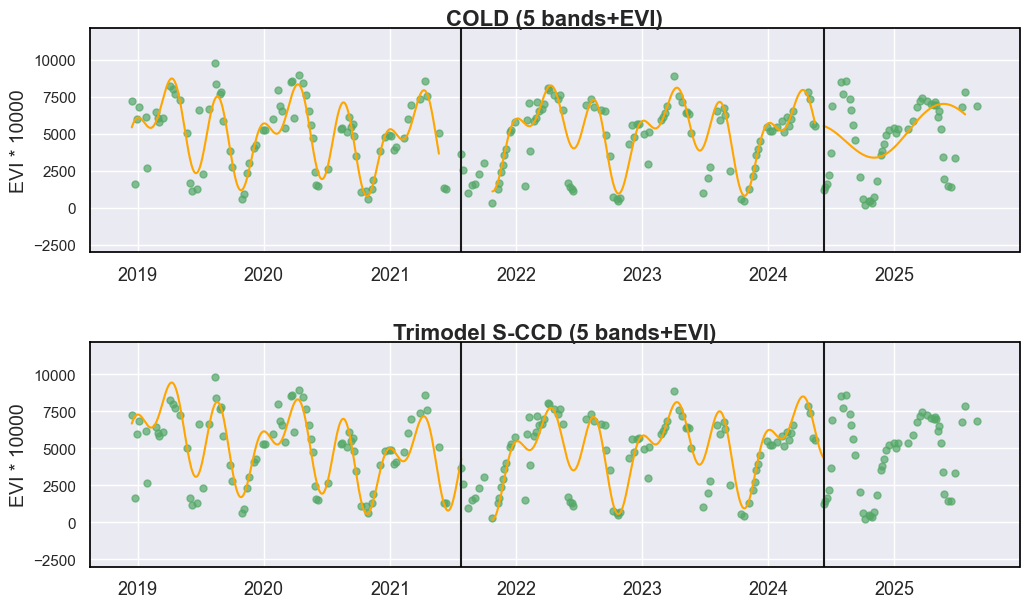
对于农业监测,增强型植被指数(EVI)被广泛用于捕捉作物生长动态和植被生理状态。在本实验中,我们选择了五个原始的 Sentinel-2 光谱波段——绿、红、近红外、短波红外1 和短波红外2——与标准 CCDC 配置一致,并增加了一个 EVI 波段。然后,将这六个变量用作 cold_detect_flex 和 sccd_detect_flex 的输入特征:
# scale EVI to [0, 10000]
evi = 25000 * (B8 - B4) / (B8 + 6.0 * B4 - 7.5 * B2 + 10000)

sns.set_theme(style="darkgrid")
sns.set_context("notebook")

# plot time series and detection results
fig, axes = plt.subplots(2, 1, figsize=(12, 7))
plt.subplots_adjust(hspace=0.4)


cold_result = cold_detect_flex(dates.astype(np.int32), np.stack((B3, B4, B8, B11, B12, evi), axis=1).astype(np.int32), qas.astype(np.int32), lam=20,  tmask_b1_index=1, tmask_b2_index=4)

sccd_result = sccd_detect_flex(dates.astype(np.int32), np.stack((B3, B4, B8, B11, B12, evi), axis=1).astype(np.int32), qas.astype(np.int32), trimodal=True,  lam=20, tmask_b1_index=1, tmask_b2_index=4)

display_cold_result(data=np.stack((dates, B3, B4, B8, B11, B12, evi, qas), axis=1).astype(np.int64), band_names=['green', 'red', 'nir',  'swir1', 'swir2', 'EVI'], band_index=5, cold_result=cold_result, axe=axes[0], title="COLD (5 bands+EVI)")

display_sccd_result(data=np.stack((dates, B3, B4, B8, B11, B12, evi, qas), axis=1).astype(np.int64), band_names=['green', 'red', 'nir',  'swir1', 'swir2', 'EVI'], band_index=5, sccd_result=sccd_result, axe=axes[1],  title="Trimodel S-CCD (5 bands+EVI)")
总结
虽然添加 EVI 并未改变此案例的断点检测结果,但我们通常建议将 EVI 或 NDVI 作为额外的输入纳入 COLD 或 S-CCD,以加强农田监测。除了提高断点检测的稳健性外,来自 EVI 或 NDVI 的拟合谐波模型(即八个谐波系数)对于表征种植强度、监测生长阶段以及作为产量估算的代理指标非常有价值。第 9 课(物候)将展示 EVI 谐波模型在作物物候监测中的应用。