Lesson 7: near real-time monitoring
Author: Su Ye (remotesensingsuy@gmail.com)
Time series datasets: Harmonized Landsat-Sentinel (HLS) datasets
Application: logging activities in Sichuan, China
Stochastic Continuous Change Detection (S-CCD) incorporates the Kalman filter which eliminates the need to refit the entire time series whenever new data are ingested [1] . Instead, model coefficients (trend and seasonal parameters) are updated incrementally in a short-memory manner, so the algorithm does not retain the entire historical record. Once an observation is assimilated (or discarded), the raw data are no longer stored. This design makes the algorithm scalable for near real-time applications, where data arrive continuously.
[1] Ye, S., Rogan, J., Zhu, Z., & Eastman, J. R. (2021). A near-real-time approach for monitoring forest disturbance using Landsat time series: Stochastic continuous change detection. Remote Sensing of Environment, 252, 112167.
Retrospective data processing
Let’s use an HLS example from Sichuan to NRT monitoring logging activities
To enable an NRT monitoring, we need run sccd_detect or
sccd_detect_flex to process historical time-series datasets up to
the current date. Assuming that we are at the date of “2024-04-04”, we
first need to process the historical HLS dataset from 2016 to today:
import numpy as np
import pathlib
import pandas as pd
from typing import List, Tuple, Dict, Union, Optional
from matplotlib.axes import Axes
import seaborn as sns
import matplotlib.pyplot as plt
from pyxccd import sccd_detect
from pyxccd.common import SccdOutput
from pyxccd.utils import getcategory_sccd, defaults

def display_sccd_result(
    data: np.ndarray,
    band_names: List[str],
    band_index: int,
    sccd_result: SccdOutput,
    axe: Axes,
    title: str = 'S-CCD',
    plot_kwargs: Optional[Dict] = None
) -> Tuple[plt.Figure, List[plt.Axes]]:
    """
    Compare COLD and SCCD change detection algorithms by plotting their results side by side.

    This function takes time series remote sensing data, applies both COLD and SCCD algorithms,
    and visualizes the curve fitting and break detection results for comparison.

    Parameters:
    -----------
    data : np.ndarray
        Input data array with shape (n_observations, n_bands + 2) where:
        - First column: ordinal dates (days since January 1, AD 1)
        - Next n_bands columns: spectral band values
        - Last column: QA flags (0-clear, 1-water, 2-shadow, 3-snow, 4-cloud)

    band_names : List[str]
        List of band names corresponding to the spectral bands in the data (e.g., ['red', 'nir'])

    band_index : int
        1-based index of the band to plot (e.g., 0 for first band, 1 for second band)

    sccd_result: SccdOutput
        Output of sccd_detect

    axe: Axes
        An Axes object represents a single plot within that Figure

    title: Str
        The figure title. The default is "S-CCD"

    plot_kwargs : Dict, optional
        Additional keyword arguments to pass to the display function. Possible keys:
        - 'marker_size': size of observation markers (default: 5)
        - 'marker_alpha': transparency of markers (default: 0.7)
        - 'line_color': color of model fit lines (default: 'orange')
        - 'font_size': base font size (default: 14)

    Returns:
    --------
    Tuple[plt.Figure, List[plt.Axes]]
        A tuple containing the matplotlib Figure object and a list of Axes objects
        (top axis is COLD results, bottom axis is SCCD results)

    """
    w = np.pi * 2 / 365.25

    # Set default plot parameters
    default_plot_kwargs: Dict[str, Union[int, float, str]] = {
        'marker_size': 5,
        'marker_alpha': 0.7,
        'line_color': 'orange',
        'font_size': 14
    }
    if plot_kwargs is not None:
        default_plot_kwargs.update(plot_kwargs)

    # Extract values with proper type casting
    font_size = default_plot_kwargs.get('font_size', 14)
    try:
        title_font_size = int(font_size) + 2
    except (TypeError, ValueError):
        title_font_size = 16


    # Clean and prepare data
    data = data[np.all(np.isfinite(data), axis=1)]
    data_df = pd.DataFrame(data, columns=['dates'] + band_names + ['qa'])


    # Plot COLD results
    w = np.pi * 2 / 365.25
    slope_scale = 10000

    # Prepare clean data for COLD plot
    data_clean = data_df[(data_df['qa'] == 0) | (data_df['qa'] == 1)].copy()
    data_clean =  data_clean[(data_clean >= 0).all(axis=1) & (data_clean.drop(columns="dates") <= 10000).all(axis=1)]
    calendar_dates = [pd.Timestamp.fromordinal(int(row)) for row in data_clean["dates"]]
    data_clean.loc[:, 'dates_formal'] = calendar_dates

    # Calculate y-axis limits
    band_name = band_names[band_index]
    band_values = data_clean[data_clean['qa'] == 0 | (data_clean['qa'] == 1)][band_name]
    # band_values  = band_values[band_values <10000]
    q01, q99 = np.quantile(band_values, [0.01, 0.99])
    extra = (q99 - q01) * 0.4
    ylim_low = q01 - extra
    ylim_high = q99 + extra

    # Plot SCCD observations
    axe.plot(
        'dates_formal', band_name, 'go',
        markersize=default_plot_kwargs['marker_size'],
        alpha=default_plot_kwargs['marker_alpha'],
        data=data_clean
    )

    # Plot SCCD segments
    for segment in sccd_result.rec_cg:
        j = np.arange(segment['t_start'], segment['t_break'] + 1, 1)
        if len(segment['coefs'][band_index]) == 8:
            plot_df = pd.DataFrame(
                {
                'dates': j,
                'trend': j * segment['coefs'][band_index][1] / slope_scale + segment['coefs'][band_index][0],
                'annual': np.cos(w * j) * segment['coefs'][band_index][2] + np.sin(w * j) * segment['coefs'][band_index][3],
                'semiannual': np.cos(2 * w * j) * segment['coefs'][band_index][4] + np.sin(2 * w * j) * segment['coefs'][band_index][5],
                'trimodal': np.cos(3 * w * j) * segment['coefs'][band_index][6] + np.sin(3 * w * j) * segment['coefs'][band_index][7]
            })
        else:
            plot_df = pd.DataFrame(
                {
                'dates': j,
                'trend': j * segment['coefs'][band_index][1] / slope_scale + segment['coefs'][band_index][0],
                'annual': np.cos(w * j) * segment['coefs'][band_index][2] + np.sin(w * j) * segment['coefs'][band_index][3],
                'semiannual': np.cos(2 * w * j) * segment['coefs'][band_index][4] + np.sin(2 * w * j) * segment['coefs'][band_index][5],
                'trimodal': j * 0
            })
        plot_df['predicted'] = (
            plot_df['trend'] +
            plot_df['annual'] +
            plot_df['semiannual']+
            plot_df['trimodal']
        )

        # Convert dates and plot model fit
        calendar_dates = [pd.Timestamp.fromordinal(int(row)) for row in plot_df["dates"]]
        plot_df.loc[:, 'dates_formal'] = calendar_dates
        g = sns.lineplot(
            x="dates_formal", y="predicted",
            data=plot_df,
            label="Model fit",
            ax=axe,
            color=default_plot_kwargs['line_color']
        )
        if g.legend_ is not None:
            g.legend_.remove()

    # Plot near-real-time projection for SCCD if available
    if hasattr(sccd_result, 'nrt_mode') and (sccd_result.nrt_mode %10 == 1 or sccd_result.nrt_mode == 3 or sccd_result.nrt_mode %10 == 5):
        recent_obs = sccd_result.nrt_model['obs_date_since1982'][sccd_result.nrt_model['obs_date_since1982']>0]
        j = np.arange(
            sccd_result.nrt_model['t_start_since1982'].item() + defaults['COMMON']['JULIAN_LANDSAT4_LAUNCH'],
            recent_obs[-1].item()+ defaults['COMMON']['JULIAN_LANDSAT4_LAUNCH']+1,
            1
        )

        if len(sccd_result.nrt_model['nrt_coefs'][band_index]) == 8:
            plot_df = pd.DataFrame(
                {
                'dates': j,
                'trend': j * sccd_result.nrt_model['nrt_coefs'][band_index][1] / slope_scale + sccd_result.nrt_model['nrt_coefs'][band_index][0],
                'annual': np.cos(w * j) * sccd_result.nrt_model['nrt_coefs'][band_index][2] + np.sin(w * j) * sccd_result.nrt_model['nrt_coefs'][band_index][3],
                'semiannual': np.cos(2 * w * j) * sccd_result.nrt_model['nrt_coefs'][band_index][4] + np.sin(2 * w * j) * sccd_result.nrt_model['nrt_coefs'][band_index][5],
                'trimodal': np.cos(3 * w * j) * sccd_result.nrt_model['nrt_coefs'][band_index][6] + np.sin(3 * w * j) * sccd_result.nrt_model['nrt_coefs'][band_index][7]
            })
        else:
            plot_df = pd.DataFrame(
                {
                'dates': j,
                'trend': j * sccd_result.nrt_model['nrt_coefs'][band_index][1] / slope_scale + sccd_result.nrt_model['nrt_coefs'][band_index][0],
                'annual': np.cos(w * j) * sccd_result.nrt_model['nrt_coefs'][band_index][2] + np.sin(w * j) * sccd_result.nrt_model['nrt_coefs'][band_index][3],
                'semiannual': np.cos(2 * w * j) * sccd_result.nrt_model['nrt_coefs'][band_index][4] + np.sin(2 * w * j) * sccd_result.nrt_model['nrt_coefs'][band_index][5],
                'trimodal': j * 0
            })

        plot_df['predicted'] = plot_df['trend'] + plot_df['annual'] + plot_df['semiannual']+ plot_df['trimodal']
        calendar_dates = [pd.Timestamp.fromordinal(int(row)) for row in plot_df["dates"]]
        plot_df.loc[:, 'dates_formal'] = calendar_dates
        g = sns.lineplot(
            x="dates_formal", y="predicted",
            data=plot_df,
            label="Model fit",
            ax=axe,
            color=default_plot_kwargs['line_color']
        )
        if g.legend_ is not None:
            g.legend_.remove()

    for i in range(len(sccd_result.rec_cg)):
        if getcategory_sccd(sccd_result.rec_cg, i) == 1:
            axe.axvline(pd.Timestamp.fromordinal(sccd_result.rec_cg[i]['t_break']), color='k')
        else:
            axe.axvline(pd.Timestamp.fromordinal(sccd_result.rec_cg[i]['t_break']), color='r')

    axe.set_ylabel(f"{band_name} * 10000", fontsize=default_plot_kwargs['font_size'])

    # Handle tick params with type safety
    tick_font_size = default_plot_kwargs['font_size']
    if isinstance(tick_font_size, (int, float)):
        axe.tick_params(axis='x', labelsize=int(tick_font_size)-1)
    else:
        axe.tick_params(axis='x', labelsize=13)  # fallback

    axe.set(ylim=(ylim_low, ylim_high))
    axe.set_xlabel("", fontsize=6)

    # Format spines
    for spine in axe.spines.values():
        spine.set_edgecolor('black')
    title_font_size = int(font_size) + 2 if isinstance(font_size, (int, float)) else 16
    axe.set_title(title, fontweight="bold", size=title_font_size, pad=2)


TUTORIAL_DATASET = (pathlib.Path.cwd() / 'datasets').resolve() # modify it as you need
assert TUTORIAL_DATASET.exists()
in_path = TUTORIAL_DATASET/ '7_logging_hls_w0.csv'

# read example csv for HLS time series
data = pd.read_csv(in_path)

# split the array by the column
dates, blues, greens, reds, nirs, swir1s, swir2s, thermals, qas, sensor = data.to_numpy().copy().T

# retrospective processing
sccd_result = sccd_detect(dates, blues, greens, reds, nirs, swir1s, swir2s, qas)

sns.set_theme(style="darkgrid")
sns.set_context("notebook")

# plot time series and detection results
fig, axes = plt.subplots(2, 1, figsize=(12, 7))
plt.subplots_adjust(hspace=0.4)


# Let's plot NIR and SWIR2 time series, which are the best two disturbance indicator bands
display_sccd_result(data=np.stack((dates, blues, greens, reds, nirs, swir1s, swir2s, thermals, qas), axis=1), band_names=['blues', 'green', 'red', 'nir', 'swir1', 'swir2', 'thermals'], band_index=3, sccd_result=sccd_result, axe=axes[0], title="Retrospective S-CCD")

display_sccd_result(data=np.stack((dates, blues, greens, reds, nirs, swir1s, swir2s, thermals, qas), axis=1), band_names=['blues', 'green', 'red', 'nir', 'swir1', 'swir2', 'thermals'], band_index=5, sccd_result=sccd_result, axe=axes[1], title="Retrospective S-CCD")
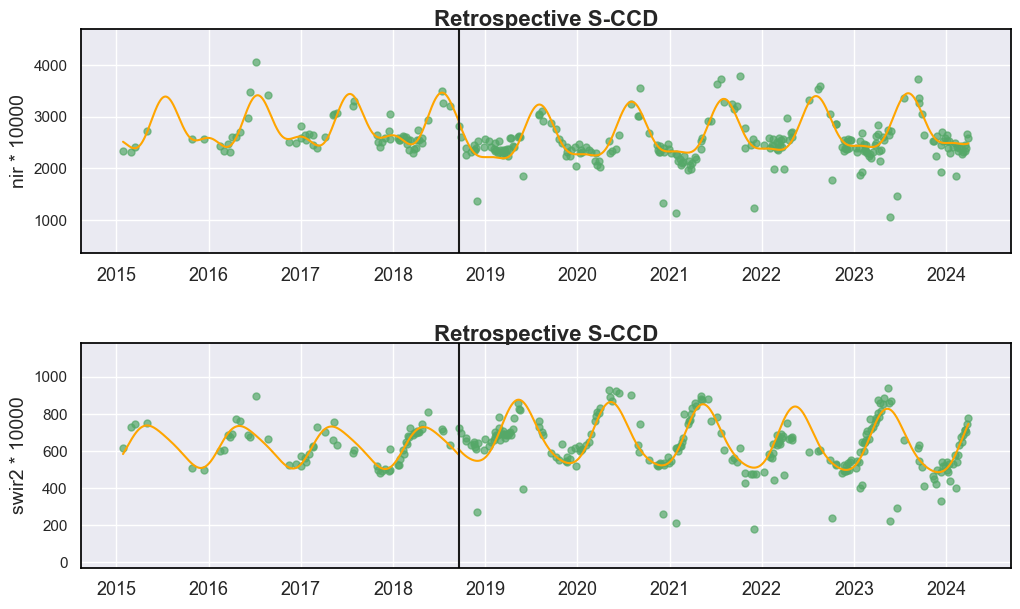
We could see a historical disturbance occurs in 2018, which is most likely due to a stress disturbance. But since this lesson is designed for NRT monitoring, we only focused the recent disturbance which is happening at the tail of the time series.
As briefly introduced in Lesson 1, sccd_result is an structured
object, which contains six elements.
Element |
Datatype |
Description |
|---|---|---|
position |
int |
Position of current pixel, commonly coded as 10000*row+col |
rec_cg |
ndarray |
Temporal segment obtained by retrospective break detection |
nrt_mode |
int |
Current mode: the 1st
digit indicate
predictability and
the 2nd is for
|
nrt_model |
ndarray |
Near real-time model for the last segment, which will be recursively updated |
nrt_queue |
ndarray |
Near real-time
observations stored
in a queue when
|
min_rmse |
ndarray |
Minimum rmse in CCDC to avoid overdetection from black body |
Let’s print the relevant nrt_model information at the current stage:
sccd_result
SccdOutput(position=1, rec_cg=array([(735625, 736954, 60, [[ 1.48542393e+04, -1.98632324e+02, -4.02296638e+01,  2.51553841e+01, -1.45135765e+01,  9.93953896e+00], [ 8.38789941e+03, -1.07453278e+02, -8.17535400e+01,  4.86201286e+01,  1.21395941e+01, -1.15295398e+00], [ 2.46381088e+02,  9.38574553e-01, -2.61588840e+01,  7.75747833e+01, -2.77891006e+01,  1.91563301e+01], [-4.81553398e+04,  6.92187561e+02, -4.14877747e+02, -2.82666321e+01,  1.99714539e+02, -4.93824234e+01], [ 2.35799585e+03, -1.30108614e+01, -1.74128586e+02,  1.30244141e+02,  2.11633873e+01,  1.98471394e+01], [ 6.30437939e+03, -7.71522598e+01, -5.81244240e+01,  9.30946274e+01, -1.19096756e+01,  1.11940117e+01]], [ 35.270123,  43.48861 ,  45.4437  , 163.38066 ,  83.16016 ,  46.84747 ], [  15.8222275,   26.901932 ,   28.303795 , -266.93457  ,  203.08496  ,  130.46231  ])],
      dtype={'names': ['t_start', 't_break', 'num_obs', 'coefs', 'rmse', 'magnitude'], 'formats': ['<i4', '<i4', '<i4', ('<f4', (6, 6)), ('<f4', (6,)), ('<f4', (6,))], 'offsets': [0, 4, 8, 12, 156, 180], 'itemsize': 204, 'aligned': True}), min_rmse=array([ 36,  35,  32, 135,  68,  35], dtype=int16), nrt_mode=1, nrt_model=np.void((13212, 194, [[ 208,  224,  294,  229,  248,  280,    0,    0], [ 429,  454,  497,  452,  489,  505,    0,    0], [ 404,  425,  454,  418,  423,  472,    0,    0], [2312, 2346, 2454, 2387, 2669, 2581,    0,    0], [1459, 1462, 1523, 1503, 1580, 1634,    0,    0], [ 688,  712,  715,  702,  743,  776,    0,    0]], [15212, 15217, 15219, 15222, 15227, 15232,     0,     0], [[102.346245, 0.04497578, -30.347172, 45.64486, -8.82943, 2.1275249, 0.04497578, 0.00013879126, -0.012609219, 0.018866414, -0.0034646979, 0.0018913492, -30.347172, -0.012609219, 119.790405, -5.1260967, -16.251162, 28.159357, 45.64486, 0.018866414, -5.1260967, 140.28548, -30.084187, -27.806128, -8.82943, -0.0034646979, -16.251162, -30.084187, 102.9957, 9.017389, 2.1275249, 0.0018913492, 28.159357, -27.806128, 9.017389, 120.91161], [107.10884, 0.048987884, -31.711811, 47.068657, -8.922271, 1.9123313, 0.048987884, 0.0001462898, -0.013710619, 0.020167004, -0.0035791849, 0.00196249, -31.711811, -0.013710619, 124.05986, -5.503266, -16.729149, 28.45994, 47.068657, 0.020167004, -5.503266, 144.86067, -30.926754, -28.806025, -8.922271, -0.0035791849, -16.729149, -30.926754, 106.99994, 9.354953, 1.9123313, 0.00196249, 28.45994, -28.806025, 9.354953, 124.93636], [119.9631, 0.05424634, -35.35254, 50.44321, -9.054462, 1.158471, 0.05424634, 0.00014838214, -0.014942498, 0.020941857, -0.0033436487, 0.0020050062, -35.35254, -0.014942498, 137.51291, -6.3354993, -18.420902, 29.369724, 50.44321, 0.020941857, -6.3354993, 159.0635, -33.54387, -31.973179, -9.054462, -0.0033436487, -18.420902, -33.54387, 119.844986, 10.4234495, 1.158471, 0.0020050062, 29.369724, -31.973179, 10.4234495, 137.8432], [270.5095, 0.12888381, -75.77823, 84.981155, -12.605128, -4.579196, 0.12888381, 0.00020805227, -0.02948218, 0.027392946, 0.00049356616, 0.007500413, -75.77823, -0.02948218, 265.0389, -15.28049, -37.84924, 37.26224, 84.981155, 0.027392946, -15.28049, 300.24518, -61.682697, -62.50038, -12.605128, 0.00049356616, -37.84924, -61.682697, 243.35031, 22.362244, -4.579196, 0.007500413, 37.26224, -62.50038, 22.362244, 262.02927], [201.3874, 0.0949685, -57.748226, 69.92133, -10.7411785, -2.253249, 0.0949685, 0.00018210562, -0.023727853, 0.025870612, -0.0016557443, 0.004314661, -57.748226, -0.023727853, 210.62979, -11.125076, -29.022526, 33.581055, 69.92133, 0.025870612, -11.125076, 238.27393, -48.60641, -48.75678, -10.7411785, -0.0016557443, -29.022526, -48.60641, 190.04839, 16.61674, -2.253249, 0.004314661, 33.581055, -48.75678, 16.61674, 208.46994], [130.30319, 0.060314957, -38.273083, 53.171722, -9.230985, 0.67056316, 0.060314957, 0.00015543179, -0.016456433, 0.0222466, -0.0032705672, 0.002172302, -38.273083, -0.016456433, 147.19635, -7.0093193, -19.689304, 29.95765, 53.171722, 0.0222466, -7.0093193, 169.38004, -35.444485, -34.178364, -9.230985, -0.0032705672, -19.689304, -35.444485, 129.04063, 11.181543, 0.67056316, 0.002172302, 29.95765, -34.178364, 11.181543, 147.07889]], [[4478.114, -57.458527, -51.625023, 53.003376, -3.087816, -1.4335045], [4847.253, -59.154026, -98.957275, 57.93207, 12.371733, 3.2117136], [7299.53, -94.44655, -39.032204, 108.598015, -24.481653, 3.4193916], [-107754.68, 1496.6321, -470.6851, -155.14989, 133.37932, 76.867035], [31400.36, -405.64944, -218.80751, 180.55144, -4.065642, -7.789848], [25347.256, -334.49185, -84.89389, 142.63063, -19.270958, -13.397055]], [1998.7078, 2154.9038, 2691.485, 10128.377, 6481.8506, 3107.4956], [ 226549,  217558,  310620, 5765251, 1759864,  593911], -9999, -9999, 0), dtype={'names': ['t_start_since1982', 'num_obs', 'obs', 'obs_date_since1982', 'covariance', 'nrt_coefs', 'H', 'rmse_sum', 'norm_cm', 'cm_angle', 'anomaly_conse'], 'formats': ['<i2', '<i2', ('<i2', (6, 8)), ('<i2', (8,)), ('<f4', (6, 36)), ('<f4', (6, 6)), ('<f4', (6,)), ('<u4', (6,)), '<i2', '<i2', 'u1'], 'offsets': [0, 2, 4, 100, 116, 980, 1124, 1148, 1172, 1174, 1176], 'itemsize': 1180, 'aligned': True}), nrt_queue=array([], dtype=float64))
# check if the current mode is still 1
print(f"The current nrt mode is {sccd_result.nrt_mode}")

# check the number of current anomlies
print(f"The current number of consecutive anomlies is {sccd_result.nrt_model['anomaly_conse']}")
recent_obs_date = sccd_result.nrt_model['obs_date_since1982'][sccd_result.nrt_model['obs_date_since1982']>0][-1]

# check the last observation to be processed. Note that the observation date was formated the ordinal dates since the date of LANDSAT4_LAUNCH (723742) to save the date into int16. The user need to convert it to the formal date through the below code
print(f"The date of the last observations being processed is {pd.Timestamp.fromordinal(recent_obs_date.item() +defaults['COMMON']['JULIAN_LANDSAT4_LAUNCH'])}")

print(f"The observation number in the current segment is {sccd_result.nrt_model['num_obs']}")
The current nrt mode is 1
The current number of consecutive anomlies is 0
The date of the last observations being processed is 2024-03-29 00:00:00
The observation number in the current segment is 194
nrt_mode = 1 means that this pixel is currently in the NRT
monitoring stage and has predictability. nrt_mode has two digits.
First digit:
0 - has predictability
1 - has no predictability
Second digit:
0 - void mode, not intialized yet
1 - monitoring mode
2 - queue mode. Once the break is detected, the mode is transition from monitoring to queue mode
3 - monitoring mode for snow
4 - queue mode for snow
5 - transition mode from monitoring to queue mode (keep nrt_model and nrt_queue both), keeping 15 days since the break is first detected
Once an anomaly is detected but its change magnitude is only
small-to-medium, no break is triggered. In this case, S-CCD may
struggle to detect subsequent changes effectively, even though
sccd_resultretains an nrt_model. This limitation arises
because the anomaly injects additional fluctuations into the
nrt_model, reducing its stability.
To address this, S-CCD applies a predictability test with each new batch
of observations. The test evaluates three consecutive observations,
checking whether their residuals (differences from the predicted
reflectance) fall below a threshold. The first digit of nrt_mode
remains 1 until the predictability test is passed (then the first digit
will be changed to 0).
The second digit encodes the availability of nrt_model. We used
1 and 3 to indicate the availability of nrt_model
respectively in the normal and the snow scenario, and 2 and 4 to
represent a lack of nrt_model and hence collecting observations
until the CCDC initialization condition is reached (i.e., queue mode).
Bi-weekly recursive update
Week 1-2: found anomalies
Now let’s perform incremental update of sccd_result with a step of
two weeks. Let’s read the first two weeks of observations since
“2024-04-04”, and update sccd_result using sccd_update:
from pyxccd import sccd_update

TUTORIAL_DATASET = (pathlib.Path.cwd() / 'datasets').resolve() # modify it as you need
assert TUTORIAL_DATASET.exists()
in_path = TUTORIAL_DATASET/ '7_logging_hls_w12.csv'

# read example csv for HLS time series
data_1 = pd.read_csv(in_path)

# split the array by the column
dates1, blues1, greens1, reds1, nirs1, swir1s1, swir2s1, thermals1, qas1, sensor1 = data_1.to_numpy().copy().T
sccd_result = sccd_update(sccd_result, dates1, blues1, greens1, reds1, nirs1, swir1s1, swir2s1, qas1)

dates_m, blues_m, greens_m, reds_m, nirs_m, swir1s_m, swir2s_m, thermals_m, qas_m, sensor_m = np.concatenate((data, data_1)).copy().T

# plot time series and detection results
fig, axes = plt.subplots(2, 1, figsize=(12, 7))
plt.subplots_adjust(hspace=0.4)


# Let's plot NIR and SWIR2 time series, which are the best two disturbance indicator bands
display_sccd_result(data=np.stack((dates_m, blues_m, greens_m, reds_m, nirs_m, swir1s_m, swir2s_m, thermals_m, qas_m), axis=1), band_names=['blues', 'green', 'red', 'nir', 'swir1', 'swir2', 'thermals'], band_index=3, sccd_result=sccd_result, axe=axes[0], title="NRT S-CCD (Week 1-2)")

display_sccd_result(data=np.stack((dates_m, blues_m, greens_m, reds_m, nirs_m, swir1s_m, swir2s_m, thermals_m, qas_m), axis=1), band_names=['blues', 'green', 'red', 'nir', 'swir1', 'swir2', 'thermals'], band_index=5, sccd_result=sccd_result, axe=axes[1], title="NRT S-CCD (Week 1-2)")

print(f"The current nrt mode is {sccd_result.nrt_mode}")
print(f"The current number of consecutive anomlies is {sccd_result.nrt_model['anomaly_conse']}")
print(f"The observation number in the current segment is {sccd_result.nrt_model['num_obs']}")
The current nrt mode is 1
The current number of consecutive anomlies is 3
The observation number in the current segment is 197
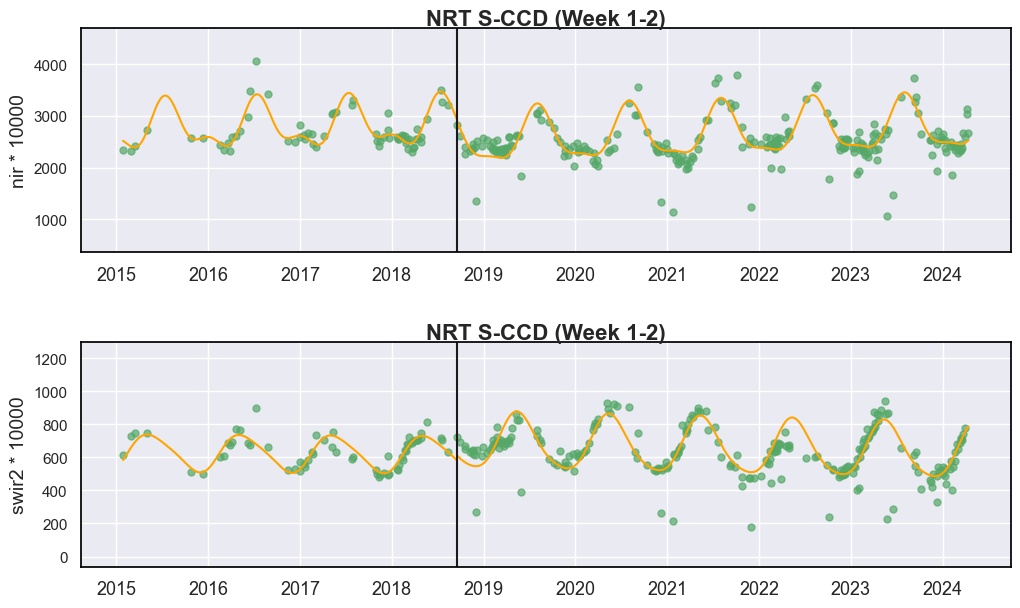
From the printed information, you can see that the number of consecutive anomalies jumps from 0 to 3, indicating that S-CCD has detected three anomalies within the most recent two weeks. These correspond to the three clear outliers at the tail of the above NIR and SWIR2 time series. The anomalies occurred because, after logging, all trees were removed from the surface, leading to increased reflectance in both almost all Landsat bands including NIR band (note that logging does not necessarily cause NIR reflectance to decrease).
At the same time, the observation count for the current segment increases from 194 to 197, confirming that three new observations have been processed and ingested into the segment during this two-week period. All three of these new observations are identified as spectral anomalies.
The sensitivity of anomaly detection can be tuned through the parameter
anomaly_pcg in sccd_update. Its default value is 0.9, which
corresponds to using the critical value of the chi-square distribution
at the 90% probability level. Lowering this threshold makes the detector
more sensitive (capturing weaker anomalies) but also increases the risk
of false positives.
Week 3-4: break detected!
in_path = TUTORIAL_DATASET/ '7_logging_hls_w34.csv'

# read example csv for HLS time series
data_2 = pd.read_csv(in_path)

# split the array by the column
dates1, blues1, greens1, reds1, nirs1, swir1s1, swir2s1, thermals1, qas1, sensor1 = data_2.to_numpy().copy().T
sccd_result = sccd_update(sccd_result, dates1, blues1, greens1, reds1, nirs1, swir1s1, swir2s1, qas1)

dates_m, blues_m, greens_m, reds_m, nirs_m, swir1s_m, swir2s_m, thermals_m, qas_m, sensor_m = np.concatenate((data, data_1, data_2)).copy().T

# plot time series and detection results
fig, axes = plt.subplots(2, 1, figsize=(12, 7))
plt.subplots_adjust(hspace=0.4)


# Let's plot NIR and SWIR2 time series, which are the best two disturbance indicator bands
display_sccd_result(data=np.stack((dates_m, blues_m, greens_m, reds_m, nirs_m, swir1s_m, swir2s_m, thermals_m, qas_m), axis=1), band_names=['blues', 'green', 'red', 'nir', 'swir1', 'swir2', 'thermals'], band_index=3, sccd_result=sccd_result, axe=axes[0], title="NRT S-CCD (Week 3-4)")

display_sccd_result(data=np.stack((dates_m, blues_m, greens_m, reds_m, nirs_m, swir1s_m, swir2s_m, thermals_m, qas_m), axis=1), band_names=['blues', 'green', 'red', 'nir', 'swir1', 'swir2', 'thermals'], band_index=5, sccd_result=sccd_result, axe=axes[1], title="NRT S-CCD (Week 3-4)")

print(f"The current nrt mode is {sccd_result.nrt_mode}")
print(f"The current number of consecutive anamlies is {sccd_result.nrt_model['anomaly_conse']}")
print(f"The observation number in the current segment is {sccd_result.nrt_model['num_obs']}")
The current nrt mode is 5
The current number of consecutive anamlies is 6
The observation number in the current segment is 200
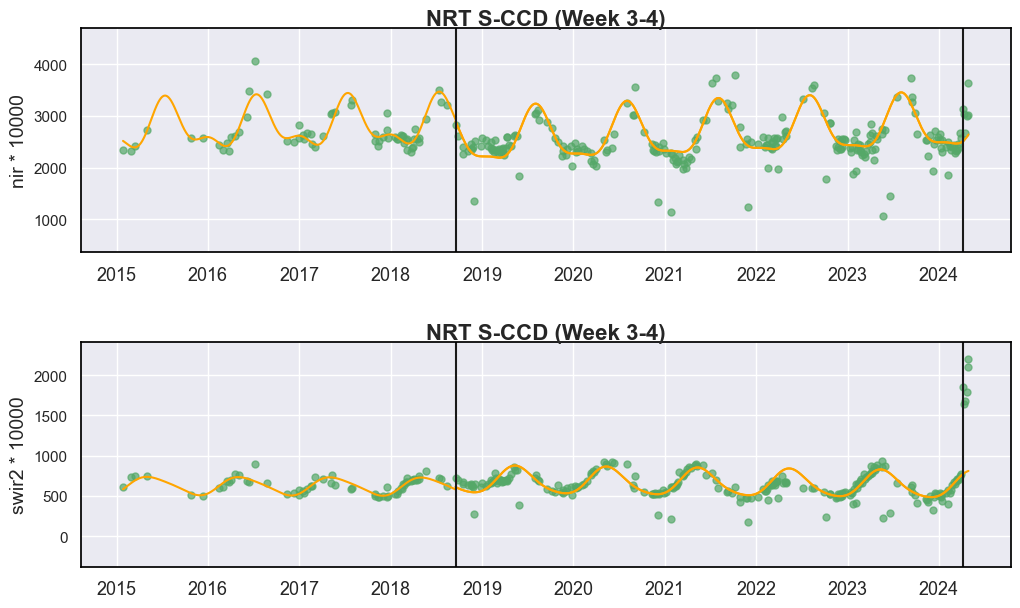
The anomaly number continues to increase from 3 to 6, triggering a break
detection. The nrt mode changed from 1 and 5. 5 here means
transitioning from ‘monitoring’ to ‘queue’, in which we will keep both
nrt_model and nrt_queue for 15 days. So the user could still
make break analysis from nrt_model. You could check the queue
observation (since the break):
print(f"The observation queue is {sccd_result.nrt_queue}")
The observation queue is [([ 594,  832,  939, 3128, 3114, 1850], 15242)
 ([ 629,  831,  924, 3027, 2836, 1637], 15243)
 ([ 582,  790,  903, 2665, 2805, 1682], 15247)
 ([ 538,  810, 1054, 2996, 3046, 1787], 15257)
 ([ 747, 1026, 1270, 3644, 3740, 2197], 15259)
 ([ 695,  948, 1261, 3026, 3333, 2099], 15262)]
Let’s make a quick check for the break type (1-disturbance; 2-recovery)
from pyxccd.utils import getcategory_sccd

print(f"The break category (1-disturbance; 2-recovery) is {getcategory_sccd(sccd_result.rec_cg, 1)}")
print(f"The recent disturbance date is {pd.Timestamp.fromordinal(sccd_result.rec_cg[-1]['t_break'])}")
The break category (1-disturbance; 2-recovery) is 1
The recent disturbance date is 2024-04-08 00:00:00
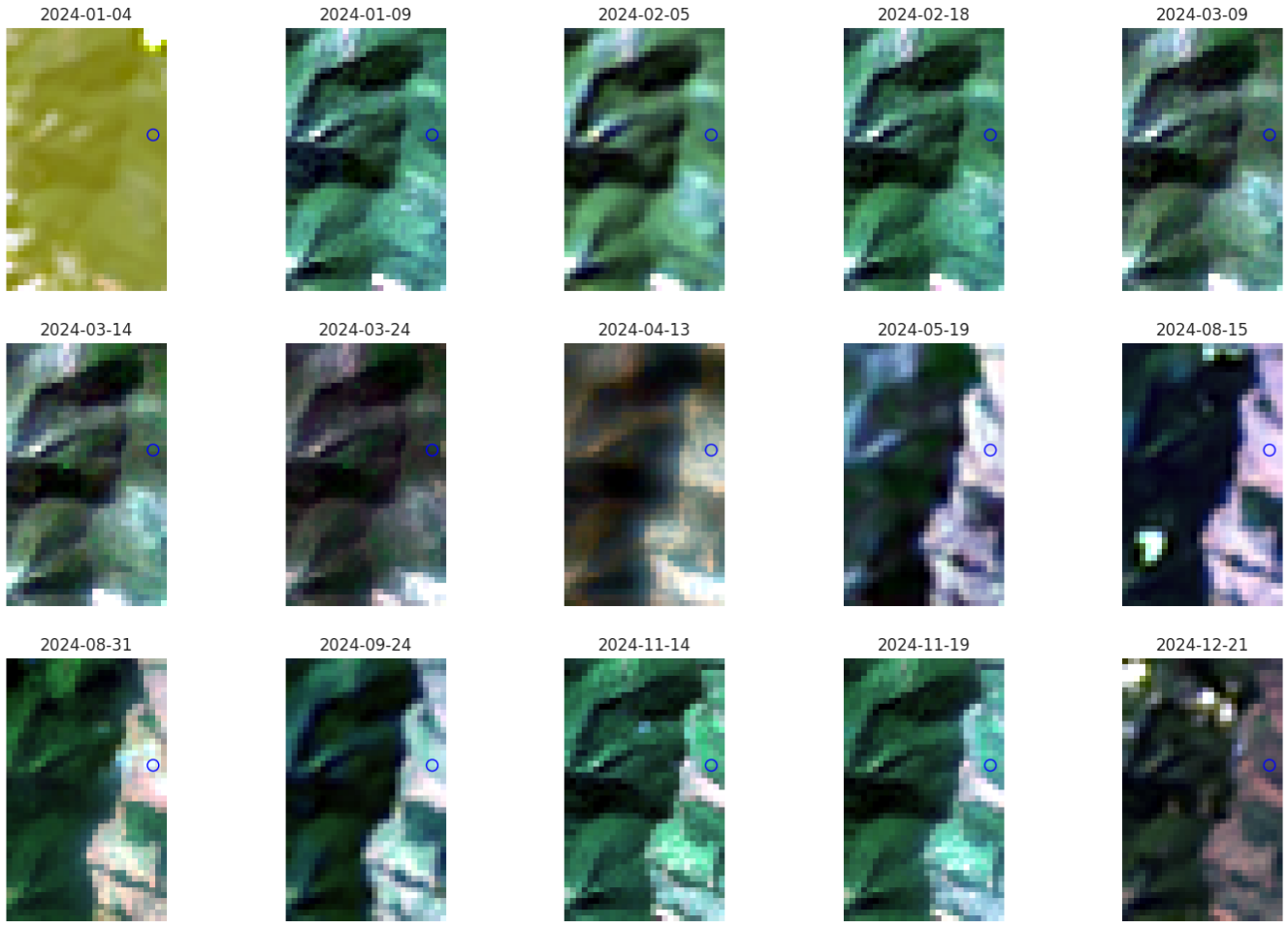
Finally, we plot the time-series Landsat images and Planet image of April. 15 to confirm the occurrence of disturbance:

Week 5-6: no clear observations
in_path = TUTORIAL_DATASET/ '7_logging_hls_w56.csv'

# read example csv for HLS time series
data_3 = pd.read_csv(in_path)

# split the array by the column
dates1, blues1, greens1, reds1, nirs1, swir1s1, swir2s1, thermals1, qas1, sensor1 = data_3.to_numpy().copy().T
sccd_result = sccd_update(sccd_result, dates1, blues1, greens1, reds1, nirs1, swir1s1, swir2s1, qas1)

dates_m, blues_m, greens_m, reds_m, nirs_m, swir1s_m, swir2s_m, thermals_m, qas_m, sensor_m = np.concatenate((data, data_1, data_2, data_3)).copy().T

# plot time series and detection results
fig, axes = plt.subplots(2, 1, figsize=(12, 7))
plt.subplots_adjust(hspace=0.4)


# Let's plot NIR and SWIR2 time series, which are the best two disturbance indicator bands
display_sccd_result(data=np.stack((dates_m, blues_m, greens_m, reds_m, nirs_m, swir1s_m, swir2s_m, thermals_m, qas_m), axis=1), band_names=['blues', 'green', 'red', 'nir', 'swir1', 'swir2', 'thermals'], band_index=3, sccd_result=sccd_result, axe=axes[0], title="NRT S-CCD (Week 5-6)")

display_sccd_result(data=np.stack((dates_m, blues_m, greens_m, reds_m, nirs_m, swir1s_m, swir2s_m, thermals_m, qas_m), axis=1), band_names=['blues', 'green', 'red', 'nir', 'swir1', 'swir2', 'thermals'], band_index=5, sccd_result=sccd_result, axe=axes[1], title="NRT S-CCD (Week 5-6)")

print(f"The current nrt mode is {sccd_result.nrt_mode}")
print(f"The current number of consecutive anamlies is {sccd_result.nrt_model['anomaly_conse']}")
print(f"The number of observation in the queue: {len(sccd_result.nrt_queue)}")
print(f"The observation queue is {sccd_result.nrt_queue}")
The current nrt mode is 5
The current number of consecutive anamlies is 6
The number of observation in the queue: 6
The observation queue is [([ 594,  832,  939, 3128, 3114, 1850], 15242)
 ([ 629,  831,  924, 3027, 2836, 1637], 15243)
 ([ 582,  790,  903, 2665, 2805, 1682], 15247)
 ([ 538,  810, 1054, 2996, 3046, 1787], 15257)
 ([ 747, 1026, 1270, 3644, 3740, 2197], 15259)
 ([ 695,  948, 1261, 3026, 3333, 2099], 15262)]
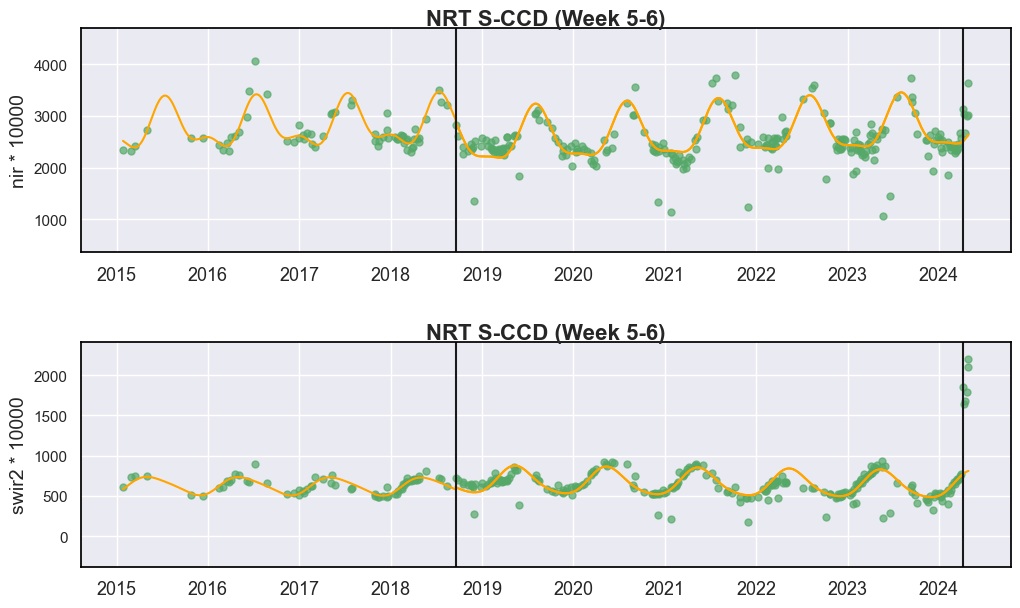
For Weeks 5–6, no clear observations are available, so neither the
nrt_model nor the nrt_queue is updated. Such cases occasionally
occur in an NRT application when no valid observations are acquired. In
this situation, monitoring is temporarily halted; however, the most
recent break information can still be retrieved from the
sccd_result.
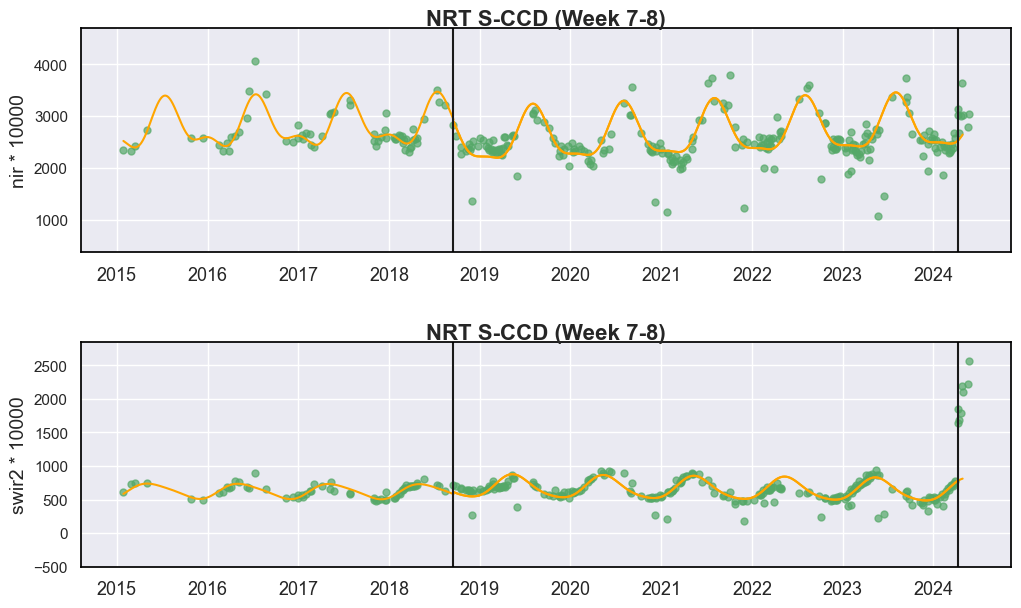
Week 7-8: collecting observations continuously after the break (6->8)
in_path = TUTORIAL_DATASET/ '7_logging_hls_w78.csv'

# read example csv for HLS time series
data_4 = pd.read_csv(in_path)

# split the array by the column
dates1, blues1, greens1, reds1, nirs1, swir1s1, swir2s1, thermals1, qas1, sensor1 = data_4.to_numpy().copy().T
sccd_result = sccd_update(sccd_result, dates1, blues1, greens1, reds1, nirs1, swir1s1, swir2s1, qas1)

dates_m, blues_m, greens_m, reds_m, nirs_m, swir1s_m, swir2s_m, thermals_m, qas_m, sensor_m = np.concatenate((data, data_1, data_2, data_3, data_4)).copy().T

# plot time series and detection results
fig, axes = plt.subplots(2, 1, figsize=(12, 7))
plt.subplots_adjust(hspace=0.4)


# Let's plot NIR and SWIR2 time series, which are the best two disturbance indicator bands
display_sccd_result(data=np.stack((dates_m, blues_m, greens_m, reds_m, nirs_m, swir1s_m, swir2s_m, thermals_m, qas_m), axis=1), band_names=['blues', 'green', 'red', 'nir', 'swir1', 'swir2', 'thermals'], band_index=3, sccd_result=sccd_result, axe=axes[0], title="NRT S-CCD (Week 7-8)")

display_sccd_result(data=np.stack((dates_m, blues_m, greens_m, reds_m, nirs_m, swir1s_m, swir2s_m, thermals_m, qas_m), axis=1), band_names=['blues', 'green', 'red', 'nir', 'swir1', 'swir2', 'thermals'], band_index=5, sccd_result=sccd_result, axe=axes[1], title="NRT S-CCD (Week 7-8)")

print(f"The current nrt mode is {sccd_result.nrt_mode}")
print(f"The current number of consecutive anamlies is {sccd_result.nrt_model['anomaly_conse']}")
print(f"The number of observation in the queue: {len(sccd_result.nrt_queue)}")
The current nrt mode is 5
The current number of consecutive anamlies is 6
The number of observation in the queue: 8
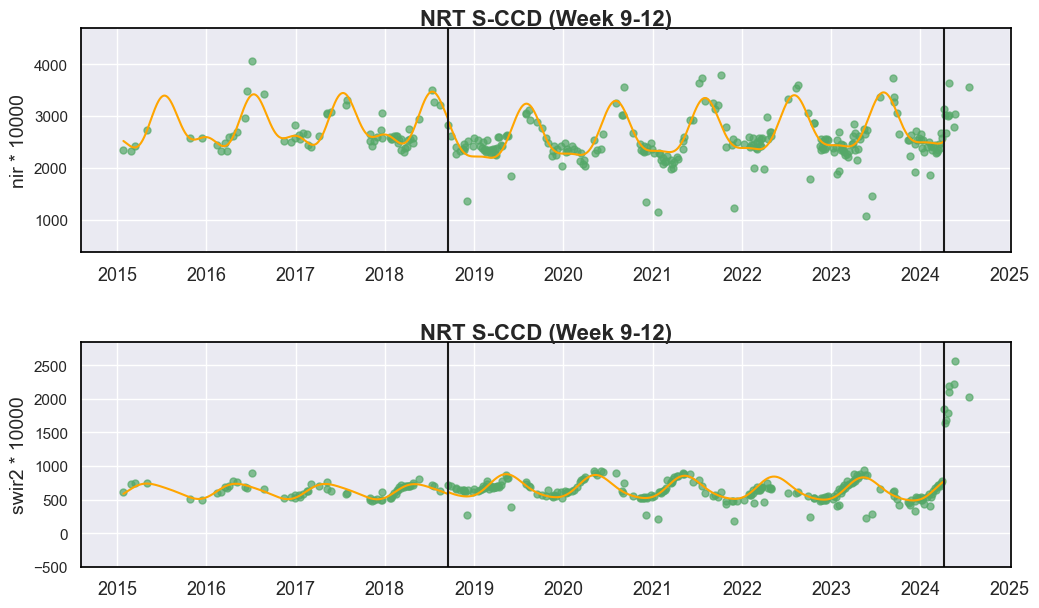
Week 9-12: irregular-interval monitoring
S-CCD allows you to input any length of new observations during the
NRT scenario. For example, if monitoring was paused for two weeks, you
may resume by running the monitoring with four weeks of observations at
once.
In this case, note that nrt_mode changed from 5 to 12. A
value of 12 indicates the queue mode (with unpredictability). From
this point onward, S-CCD begins to collect new observations until
the CCDC initialization conditions are satisfied again. During this
stage, the nrt_queue stores the incoming observations while the
nrt_model is set to None.
The transitioning mode (nrt_mode = 5) is only retained for 15 days
before switching to the queue mode.
in_path = TUTORIAL_DATASET/ '7_logging_hls_w910.csv'

# read example csv for HLS time series
data_5 = pd.read_csv(in_path)

# split the array by the column
dates1, blues1, greens1, reds1, nirs1, swir1s1, swir2s1, thermals1, qas1, sensor1 = data_5.to_numpy().copy().T
sccd_result = sccd_update(sccd_result, dates1, blues1, greens1, reds1, nirs1, swir1s1, swir2s1, qas1)

dates_m, blues_m, greens_m, reds_m, nirs_m, swir1s_m, swir2s_m, thermals_m, qas_m, sensor_m = np.concatenate((data, data_1, data_2, data_3, data_4, data_5)).copy().T

# plot time series and detection results
fig, axes = plt.subplots(2, 1, figsize=(12, 7))
plt.subplots_adjust(hspace=0.4)


# Let's plot NIR and SWIR2 time series, which are the best two disturbance indicator bands
display_sccd_result(data=np.stack((dates_m, blues_m, greens_m, reds_m, nirs_m, swir1s_m, swir2s_m, thermals_m, qas_m), axis=1), band_names=['blues', 'green', 'red', 'nir', 'swir1', 'swir2', 'thermals'], band_index=3, sccd_result=sccd_result, axe=axes[0], title="NRT S-CCD (Week 9-12)")

display_sccd_result(data=np.stack((dates_m, blues_m, greens_m, reds_m, nirs_m, swir1s_m, swir2s_m, thermals_m, qas_m), axis=1), band_names=['blues', 'green', 'red', 'nir', 'swir1', 'swir2', 'thermals'], band_index=5, sccd_result=sccd_result, axe=axes[1], title="NRT S-CCD (Week 9-12)")


print(f"The current nrt mode is {sccd_result.nrt_mode}")
print(f"nrt_model is {sccd_result.nrt_model}")
print(f"The number of observation in the queue: {len(sccd_result.nrt_queue)}")
The current nrt mode is 12
nrt_model is []
The number of observation in the queue: 9
Summary
From the above case, I demonstrated how S-CCD detects breaks in a
recursive manner. In practice, users may save the sccd_result
locally instead of storing full time-series images, which reduces data
storage requirements by approximately 90% and thus enables large-area
processing.
It is worth noting that although the break in Week 3–4 was confirmed
with six consecutive anomalies, S-CCD had already begun outputting
anomalies as early as Week 1–2. A more advanced approach is to apply
machine learning techniques to features extracted from the nrt_model,
which allows for earlier disturbance detection using fewer than six
consecutive anomalies. For details, please refer to the machine-learning
framework presented in [2].
[2] Ye, S., Zhu, Z., & Suh, J. W. (2024). Leveraging past information and machine learning to accelerate land disturbance monitoring. Remote Sensing of Environment, 305, 114071.